Eight volumes. Each one takes a single year of mathematics and works it through the way I work it through in class: the rule, why the rule has to be true, the mistakes that cost real marks, and an examination laboratory with every solution shown.
Every formula is derived rather than listed. Every worked solution has been checked. There is one author, and he teaches one to one.
Abhishek Dabas
MSc Astronautics and Space Engineering. BEng Aerospace Engineering.
Every class taught personally, since 2015.
$632$349The Complete Library · all eight volumes, one download
or a single year, $79
Every volume ships in two editions, Study and Screen. Both included. Instant download · Yours for life · 30-day money-back guarantee
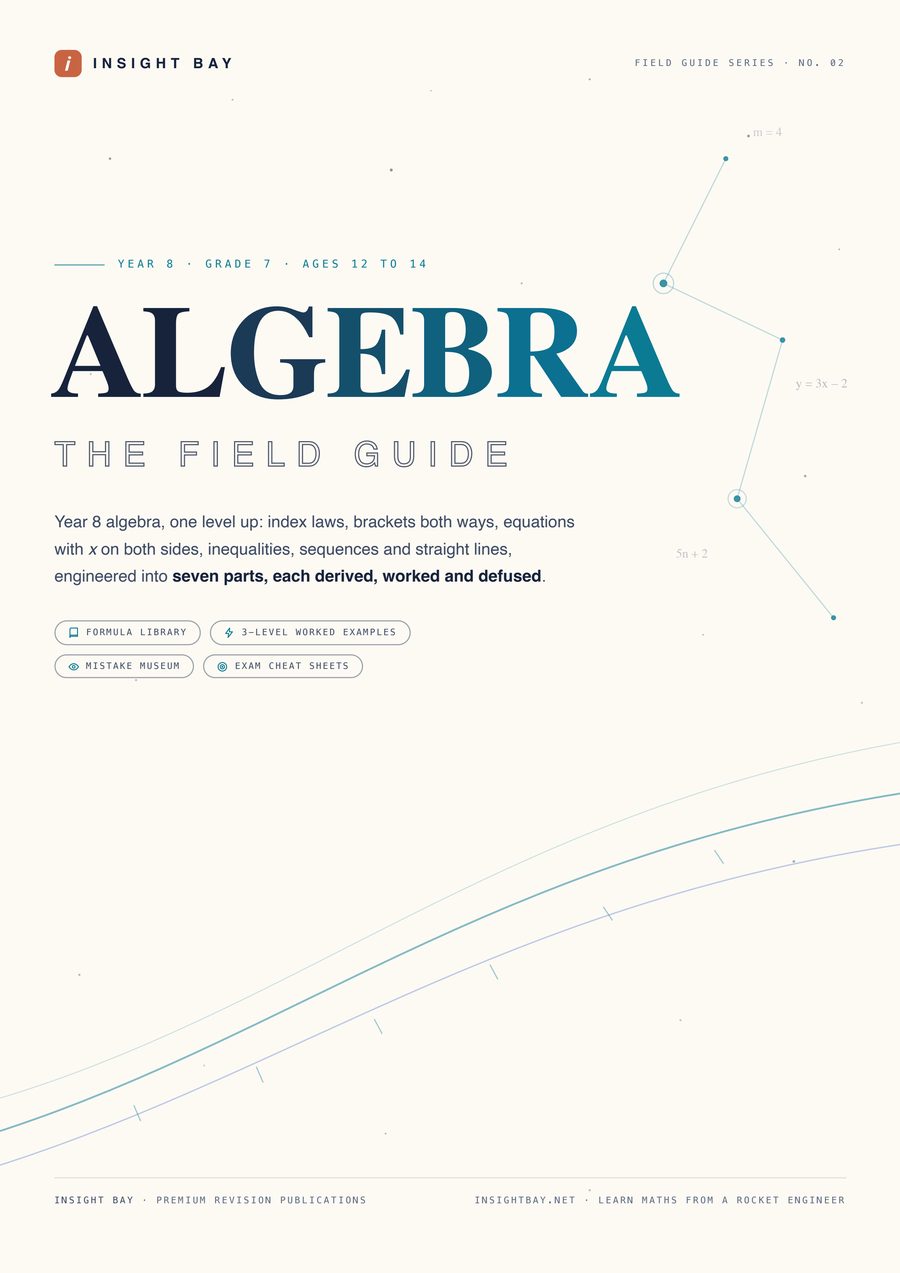
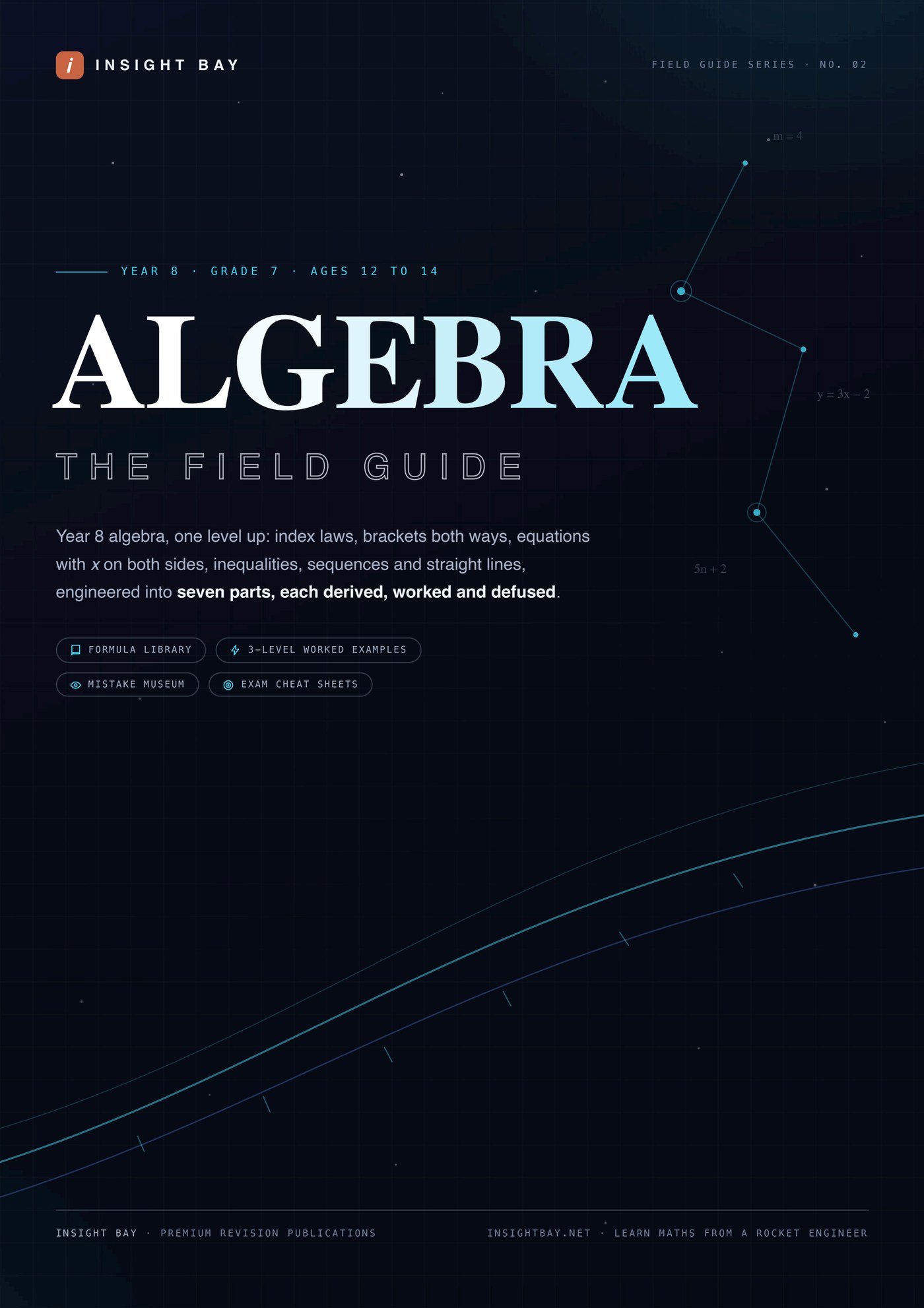
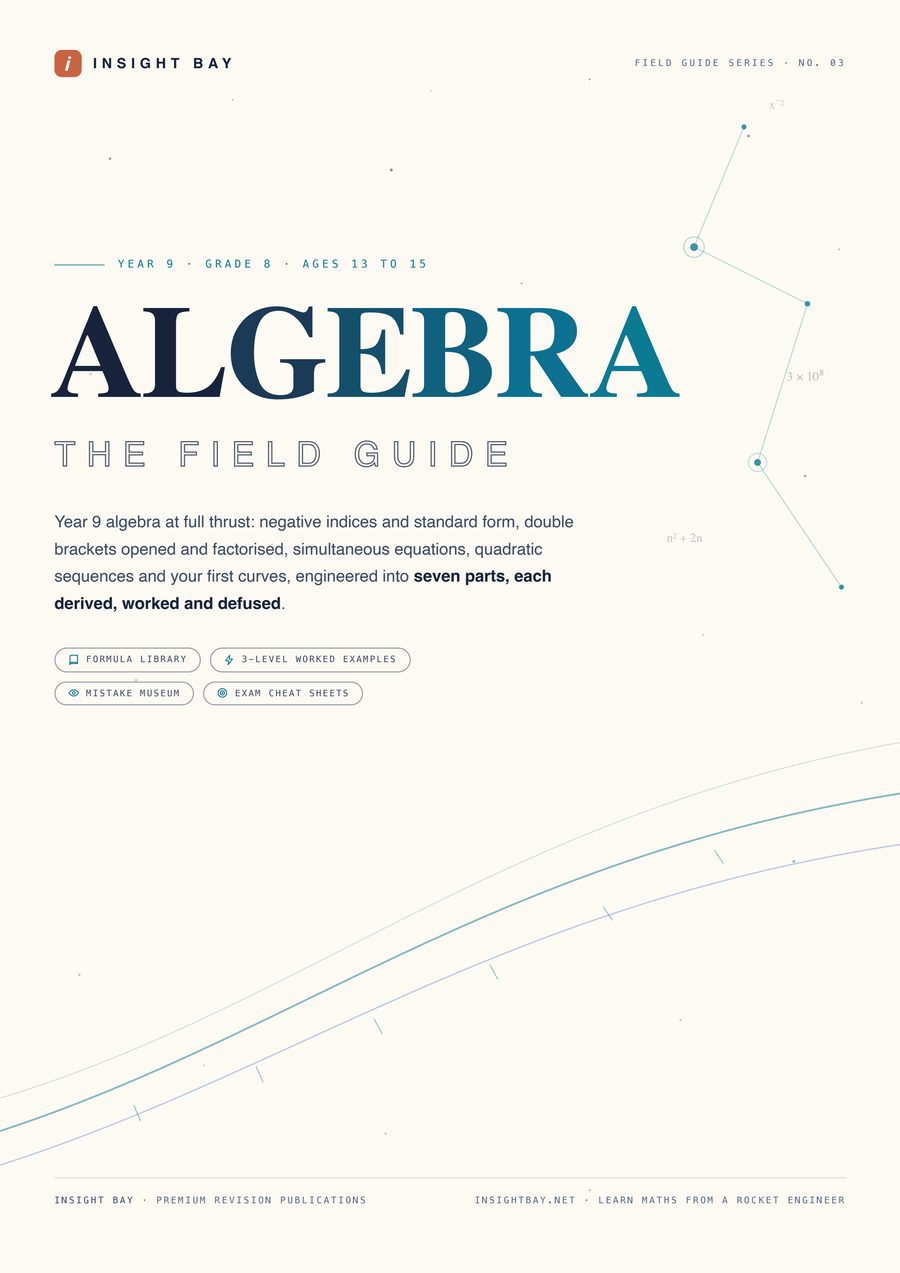
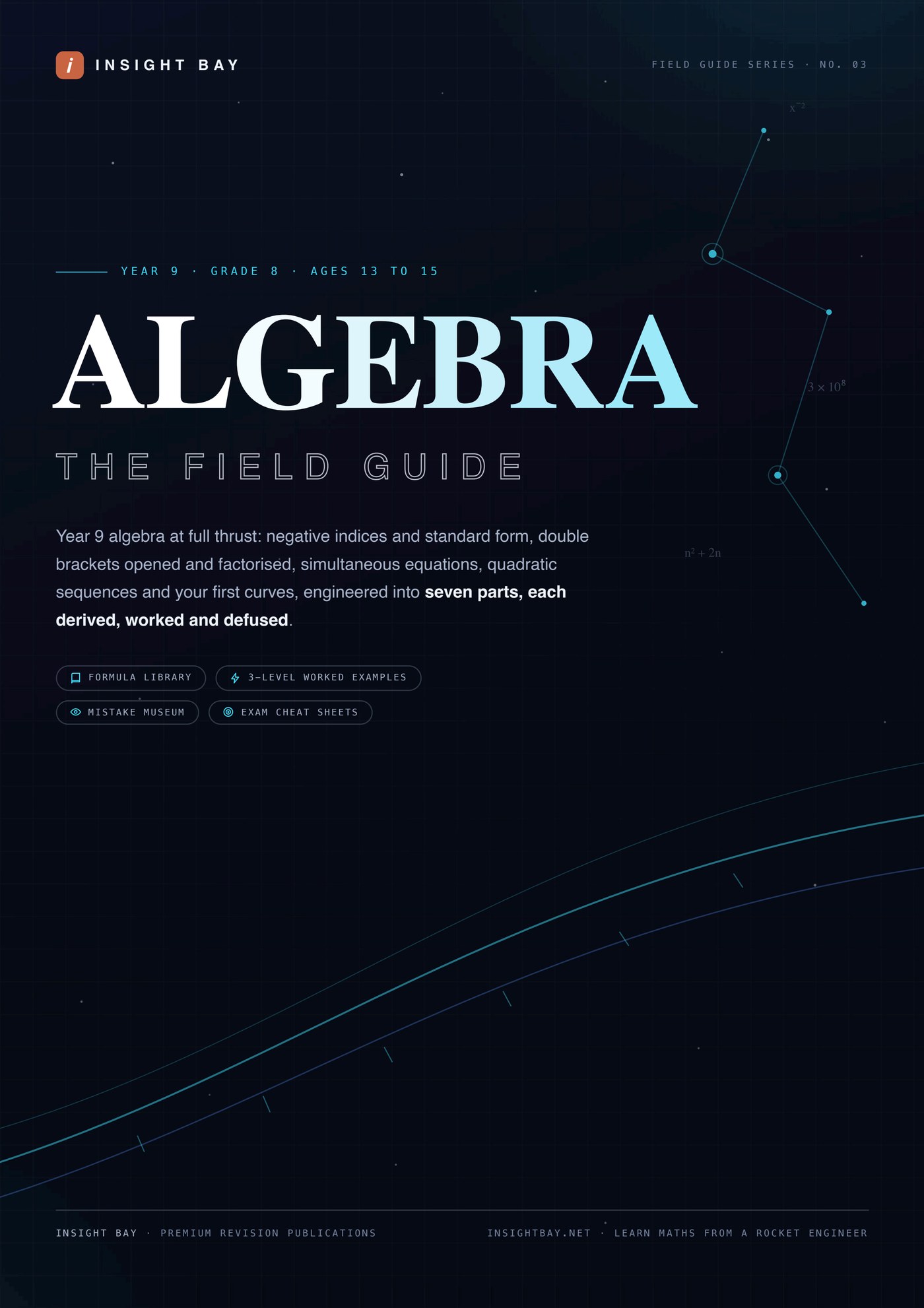
Study · printScreen · dark
One volume. Two editions. Both arrive with every purchase.
The collection
One subject, in the order it was actually built.
These are not revision guides. A revision guide summarises what a textbook already said. A Field Guide reconstructs the year: why each rule has to be true, where it breaks, and what an examiner is really asking when a question is phrased a particular way.
The formula library
Each rule stated, explained, justified and worked. The plate tells you what it means, when to use it and why it is true.
Three-level examples
Every method shown at three difficulties, so the step up is never a cliff, and a strong student can begin at level three.
Trap and fix pairs
The wrong working set beside the right working, so a misconception is corrected on sight rather than argued about later.
The Mistake Museum
A gallery of the errors that cost real marks in real papers, each one exhibited, explained and defused.
Twenty-three key facts
The non-negotiables of the year, numbered 01 to 23, so a student can find the one they are missing rather than reread the book.
The Exam Lab
Twenty-four questions under timed conditions, every one worked in full, plus the reference plates a student takes into revision.
Where they stop. A Field Guide cannot notice that your child is guessing. It cannot slow down at exactly the right moment, and it will never know which of the twenty-three facts they only appear to understand. That is what the classes are for.
What arrives
Two editions of the same page.
The volume is typeset twice, from one source. Same page numbers, same worked solutions,
same words. Only the paper changes.
Study edition. Cream paper, dark ink, light on toner. For the folder, the desk
and the printer at home.
Screen edition. Deep navy, luminous type. For a tablet or a phone, and for the
hour of revision that happens after the lights go off.
One purchase, both files. There is nothing to choose and nothing to upgrade to.
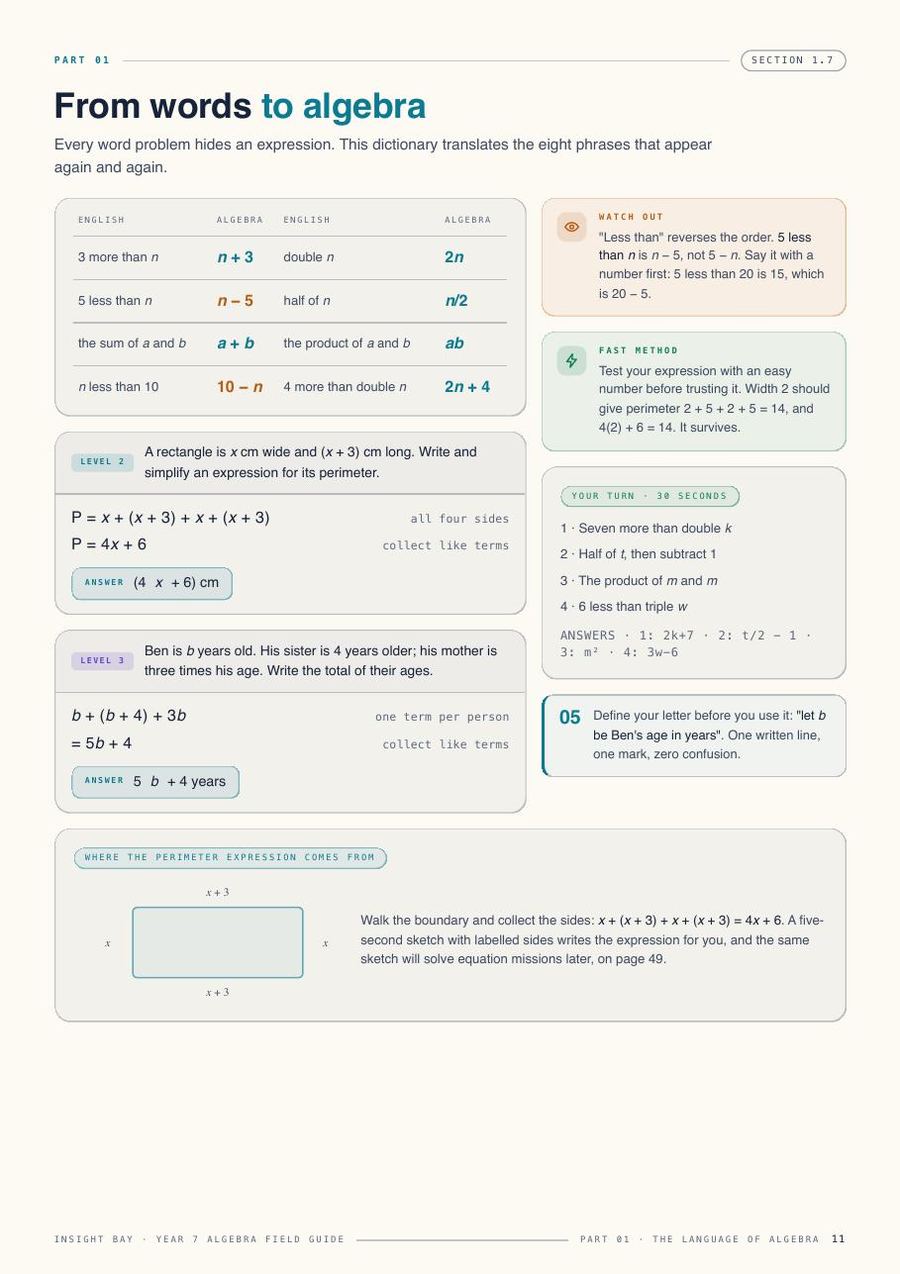
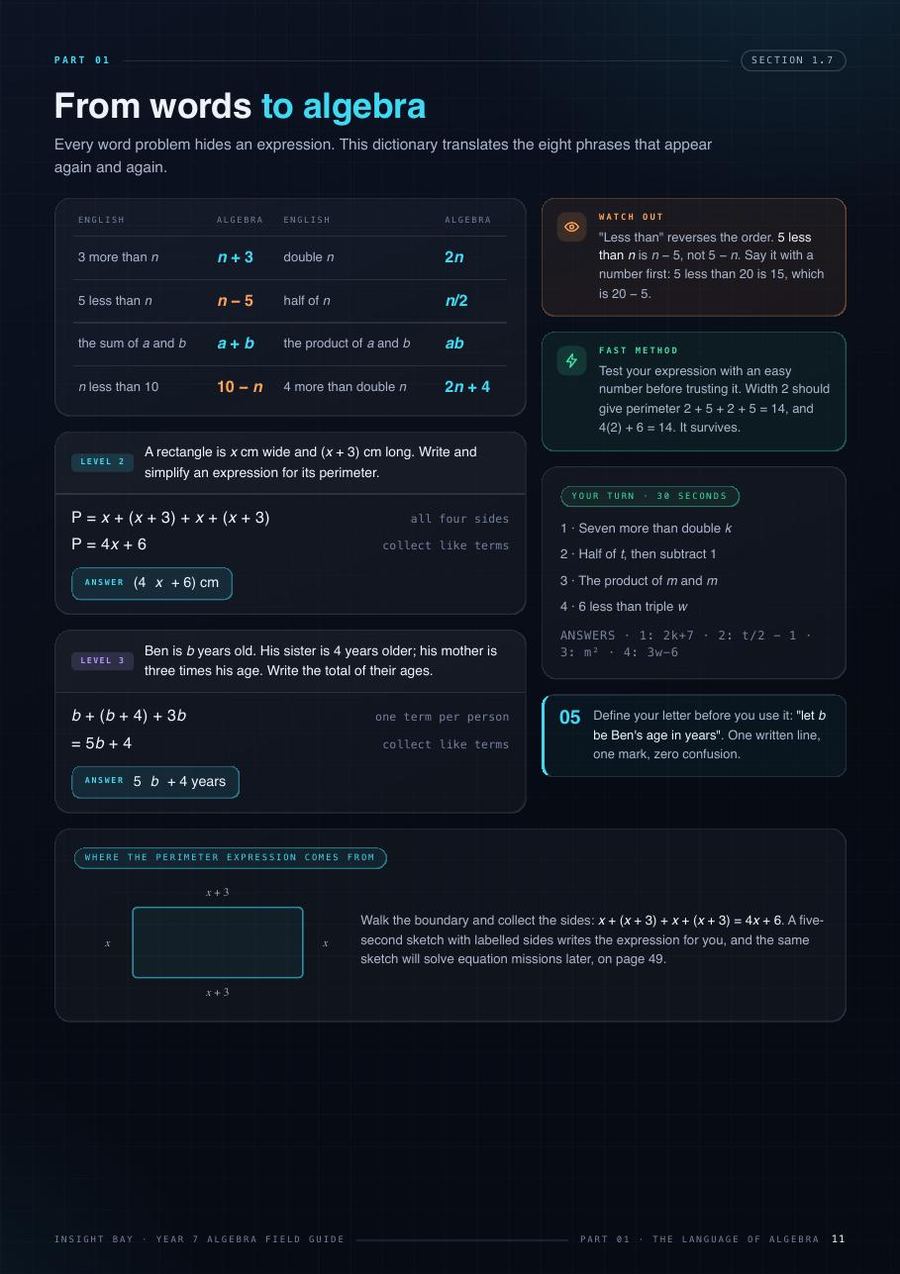
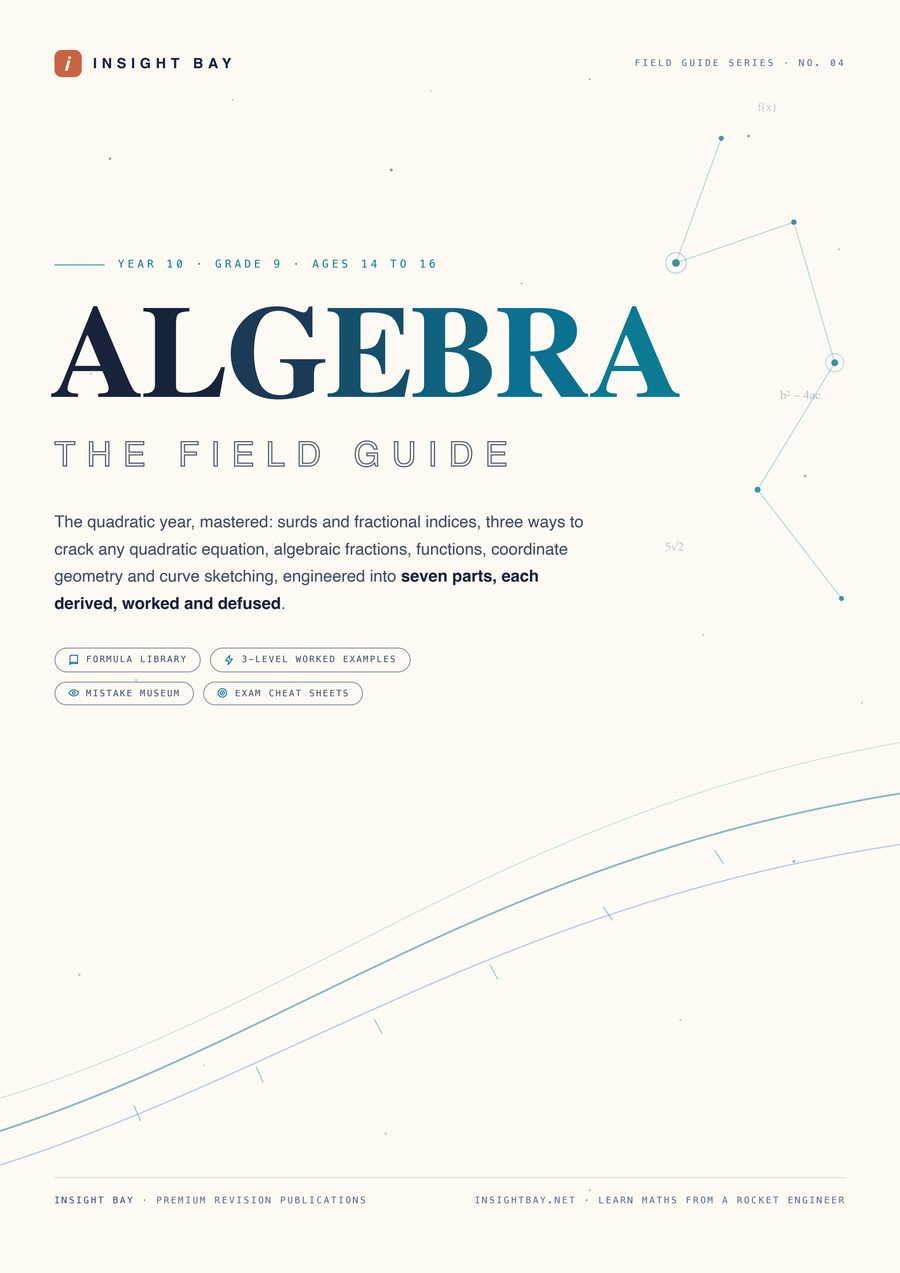
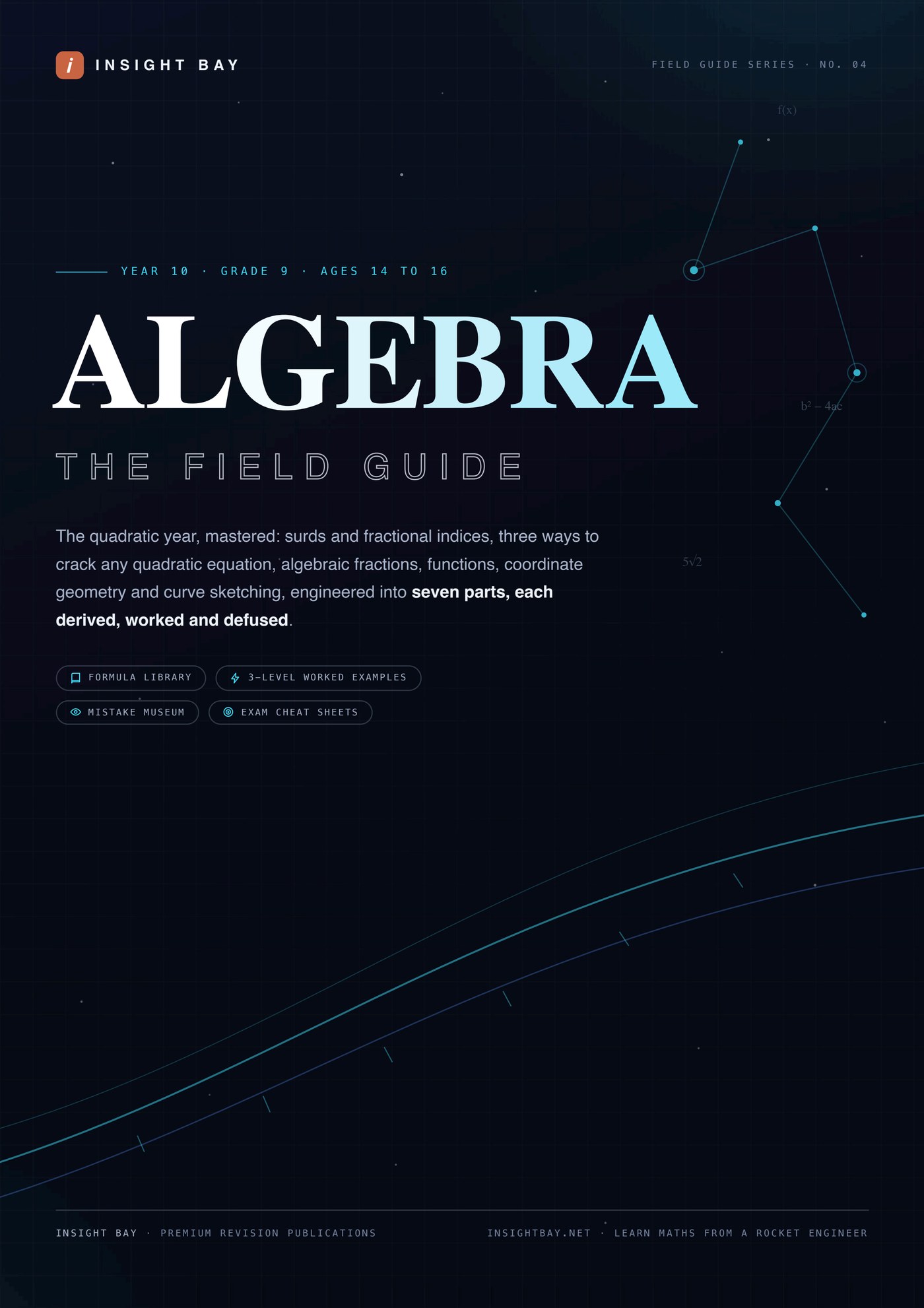
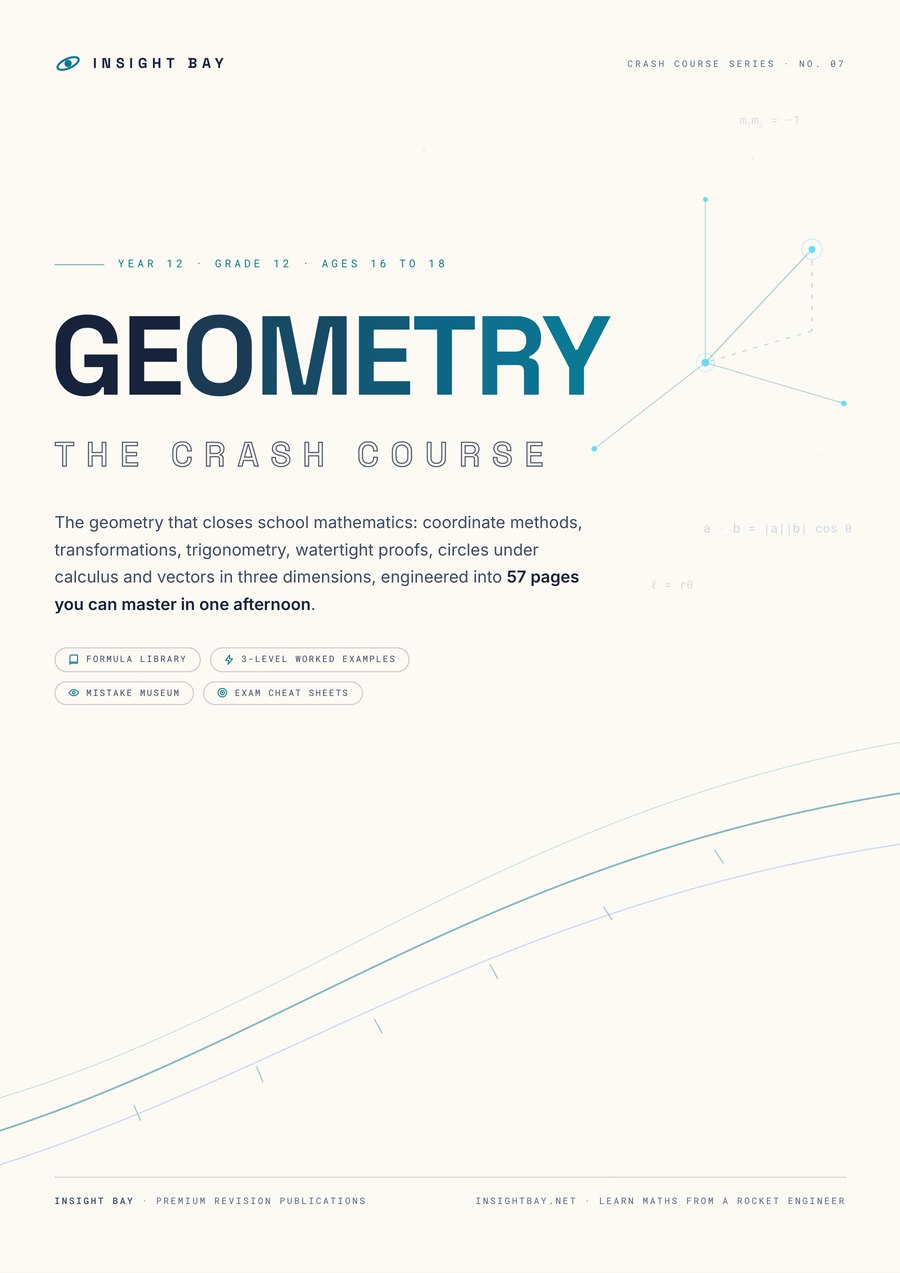
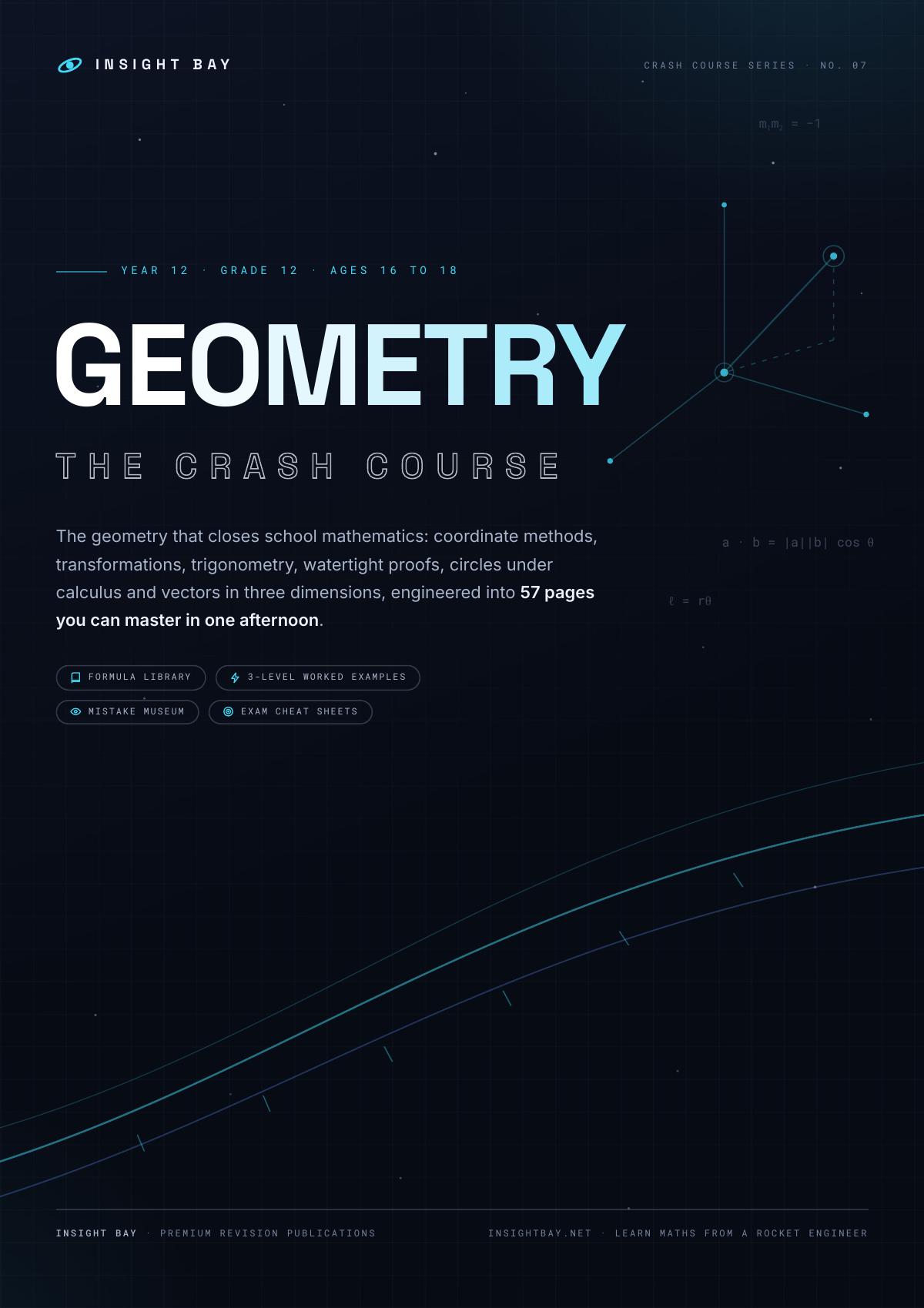
Page 11 of Volume I, shown in both editions. All eight volumes are now
published in both.
Study · page 11Screen · page 11
Find your yearEight volumes shown
Volumes I to III
The Foundation Years
Arithmetic turning into algebra. This is where the habits that decide Grade 11 are actually formed.
Where symbols stop being decoration and start being arguments. Substitution, the balance method, and the first sequences a child can predict rather than continue.
61 pages · seven parts · a full Exam Lab
Two editions included· Study for print, Screen for dark
The year algebra acquires moving parts. Index laws derived rather than memorised, brackets opened and closed again, and the first inequalities, where an answer becomes a region.
61 pages · seven parts · a full Exam Lab
Two editions included· Study for print, Screen for dark
The year the straight line bends. Simultaneous equations solved three ways, because a student who knows only one way does not yet know why any of them work.
61 pages · seven parts · a full Exam Lab
Two editions included· Study for print, Screen for dark
Volumes IV to VI
The Examination Years
Planned backwards from the date on the paper. Volume VI opens the Geometry series alongside them.
Every quadratic, by every method: factorising, completing the square, the formula, and the judgement to know which one the question is actually asking for. The volume that decides the examination year.
61 pages · seven parts · a full Exam Lab
Two editions included· Study for print, Screen for dark
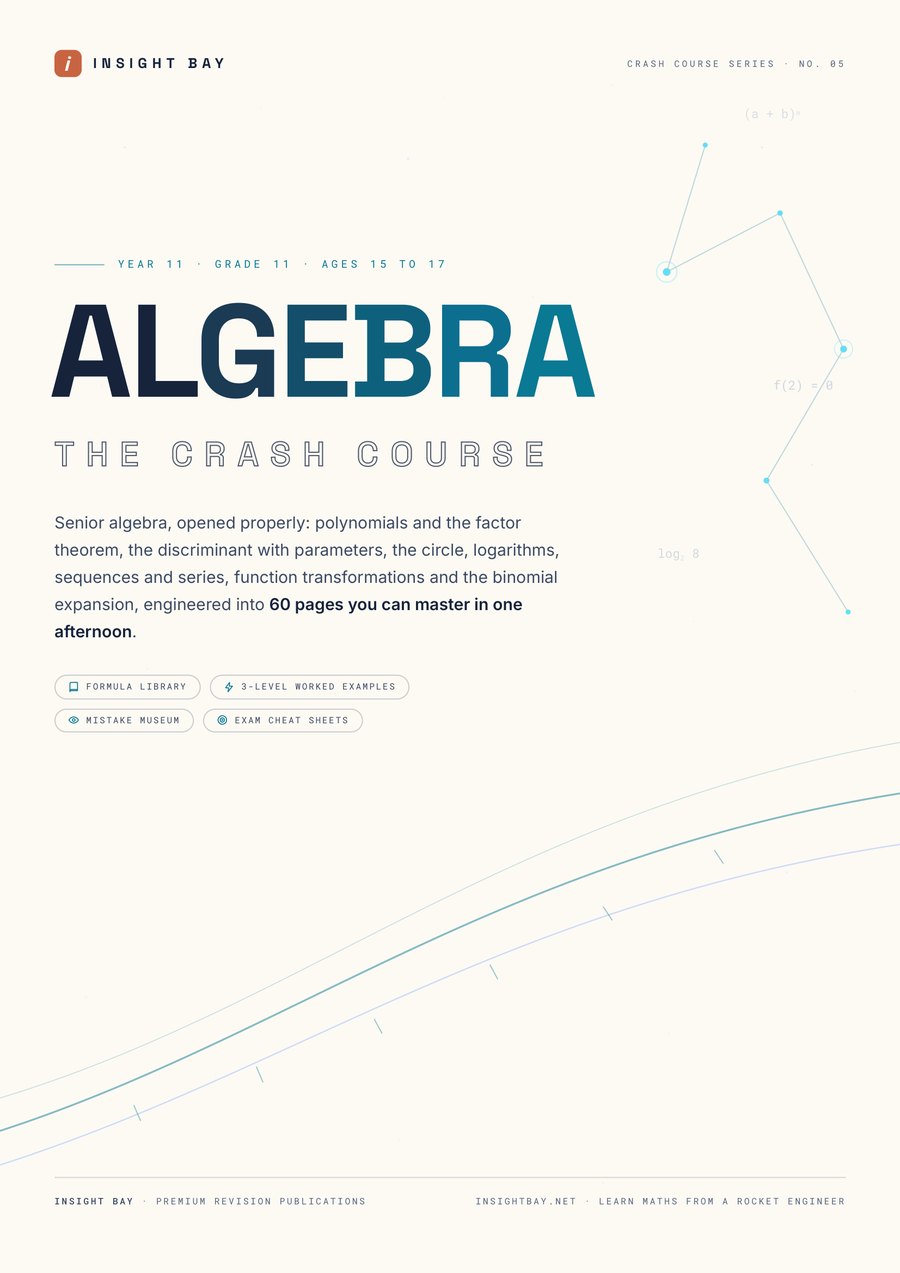
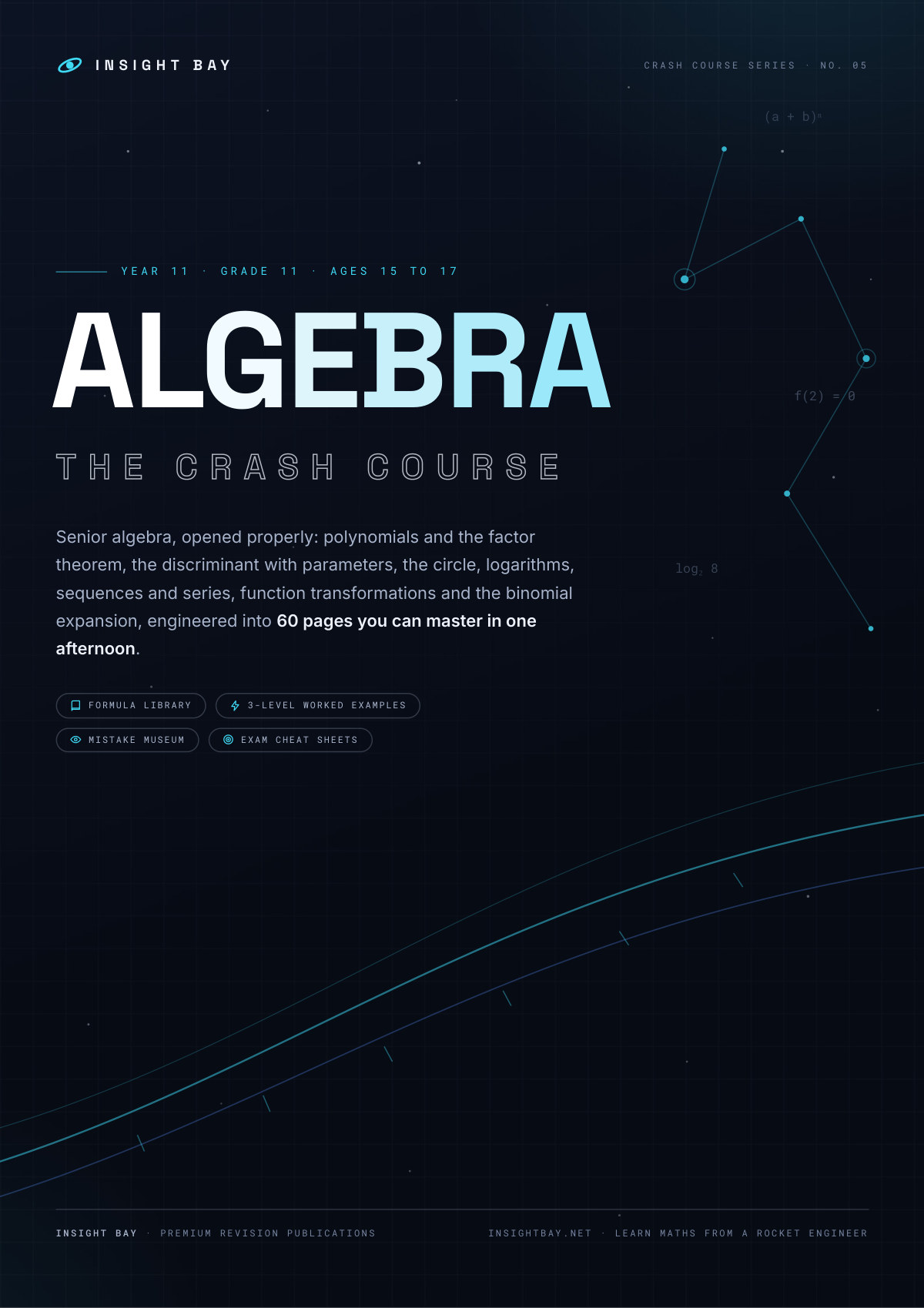
The discriminant with parameters, tangency to the circle, and the moment logarithms stop being a button. Where algebra becomes a way of asking questions about whole families of equations at once.
60 pages · seven parts · a full Exam Lab
Two editions included· Study for print, Screen for dark
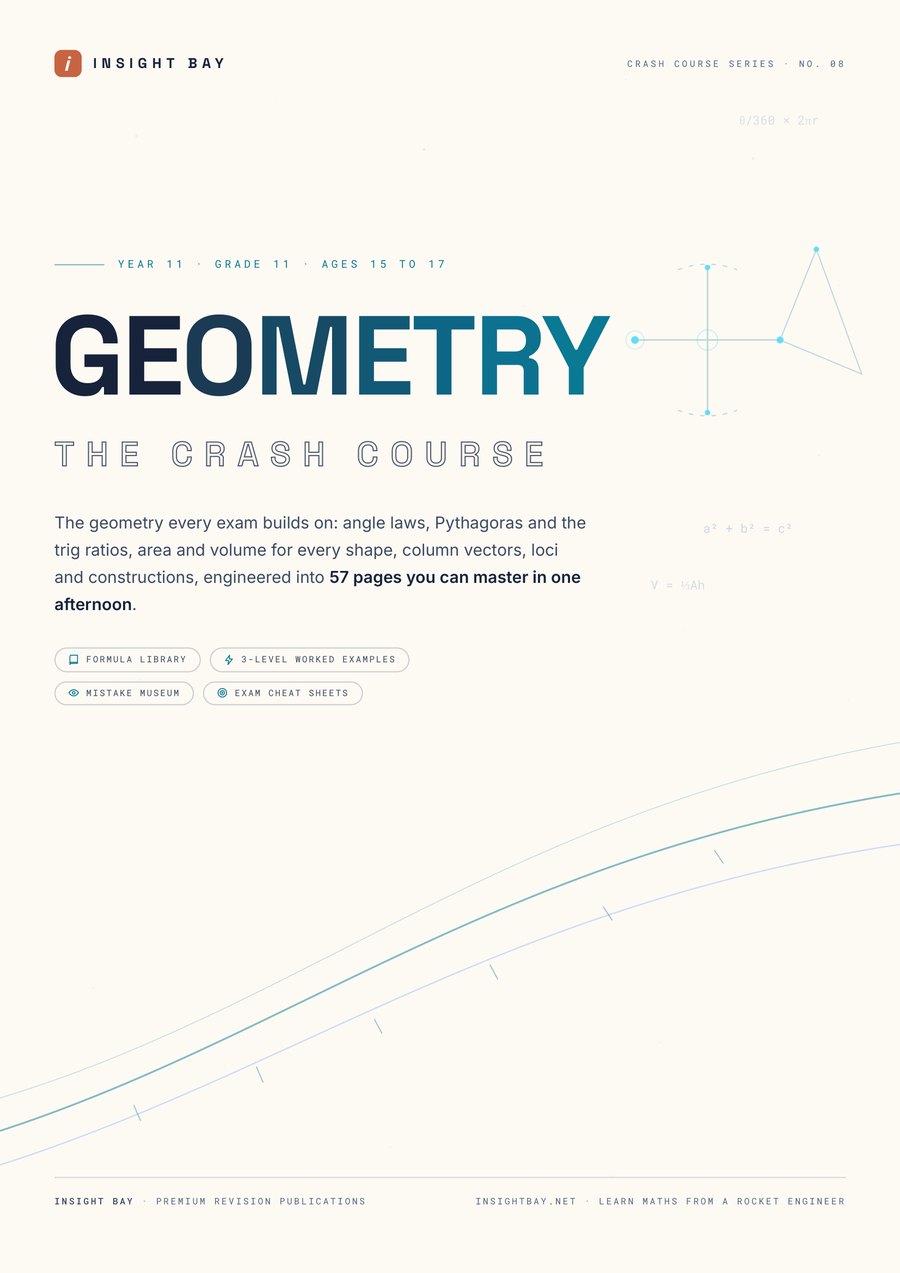
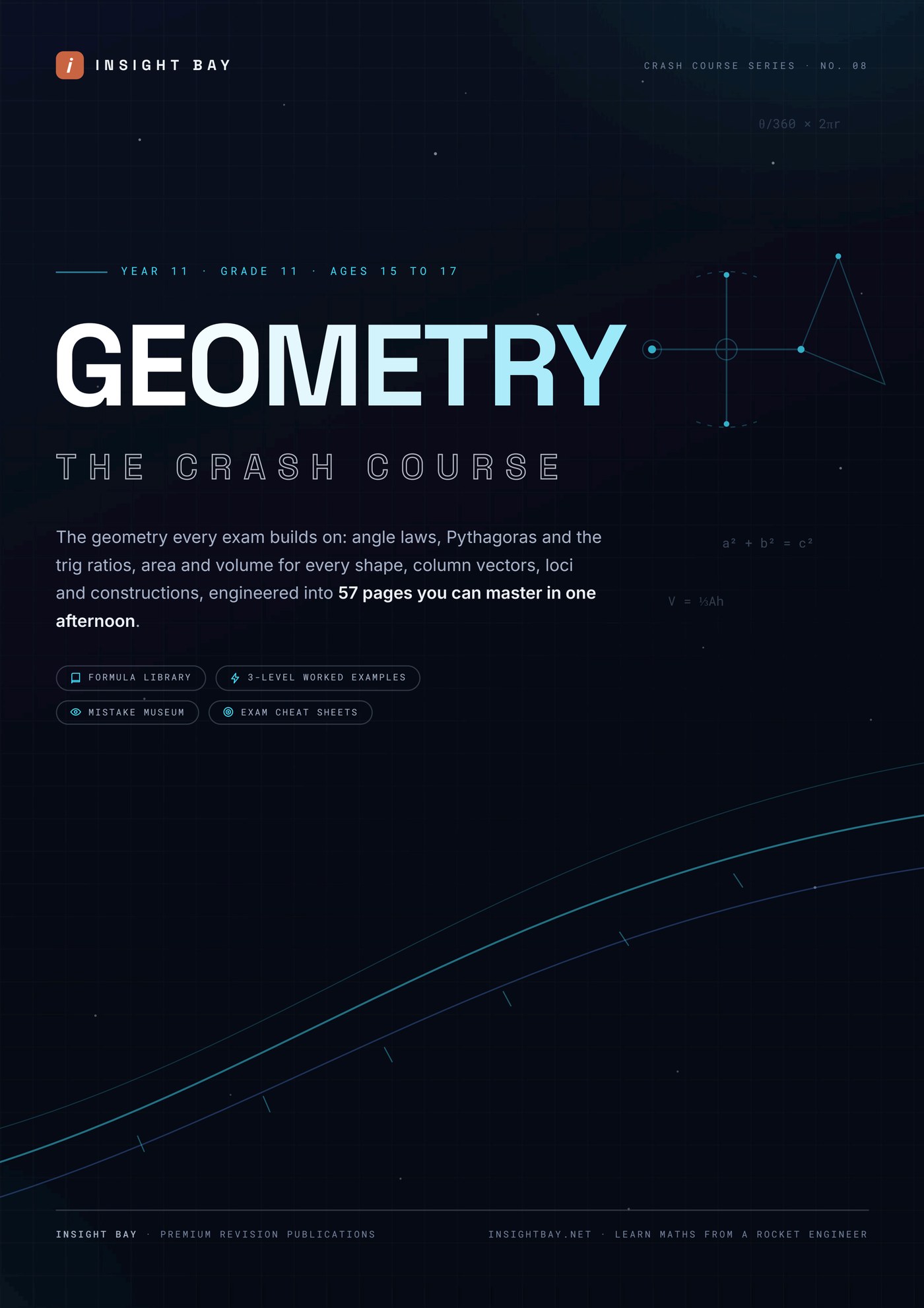
The geometry every examination is built on. Angle laws that carry their reasons, Pythagoras and the trigonometric ratios, area and volume for every shape, column vectors, loci and constructions.
57 pages · seven parts · a full Exam Lab
Two editions included· Study for print, Screen for dark
Volumes VII and VIII
Beyond the Syllabus
Written for the student who has already finished what school intends to teach them.
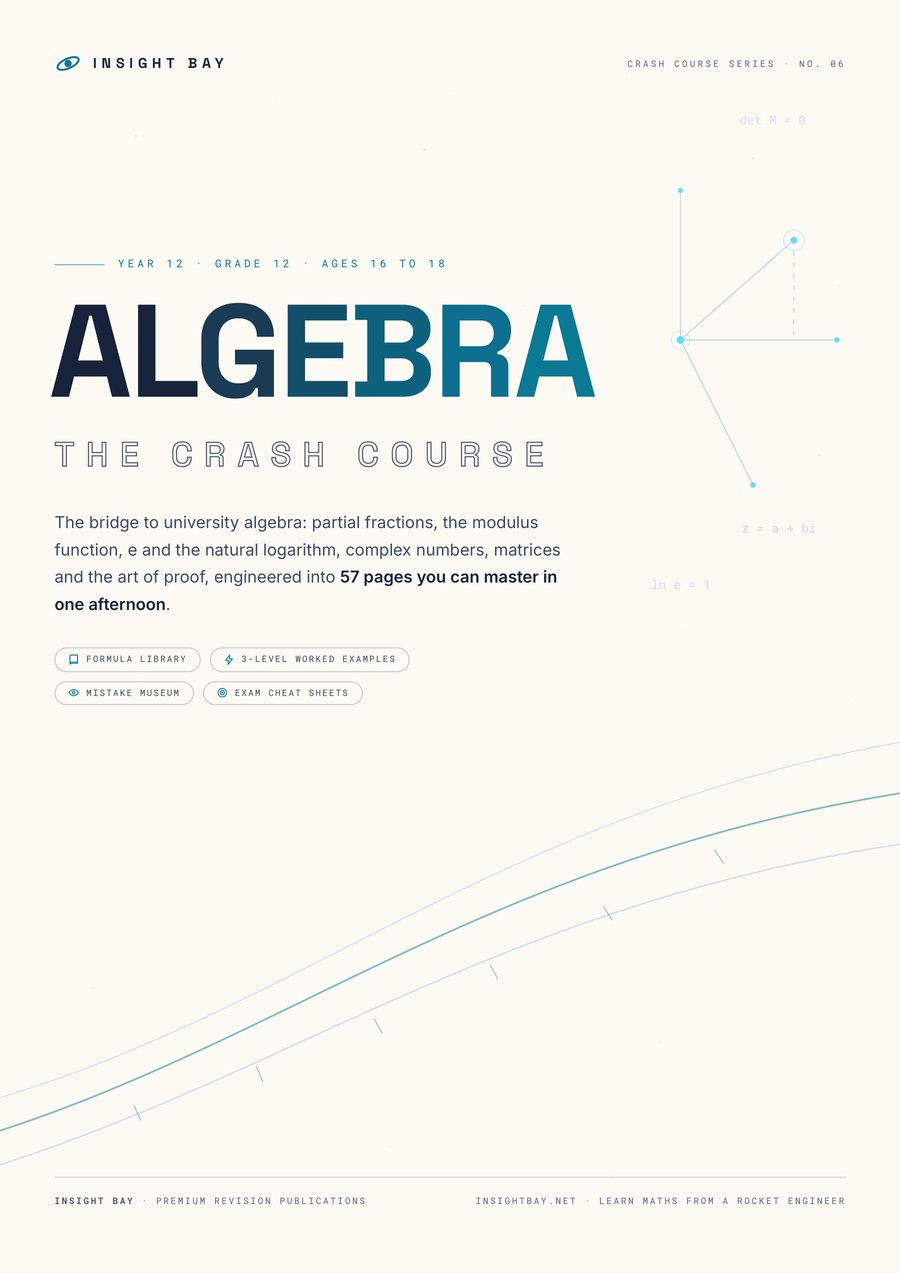
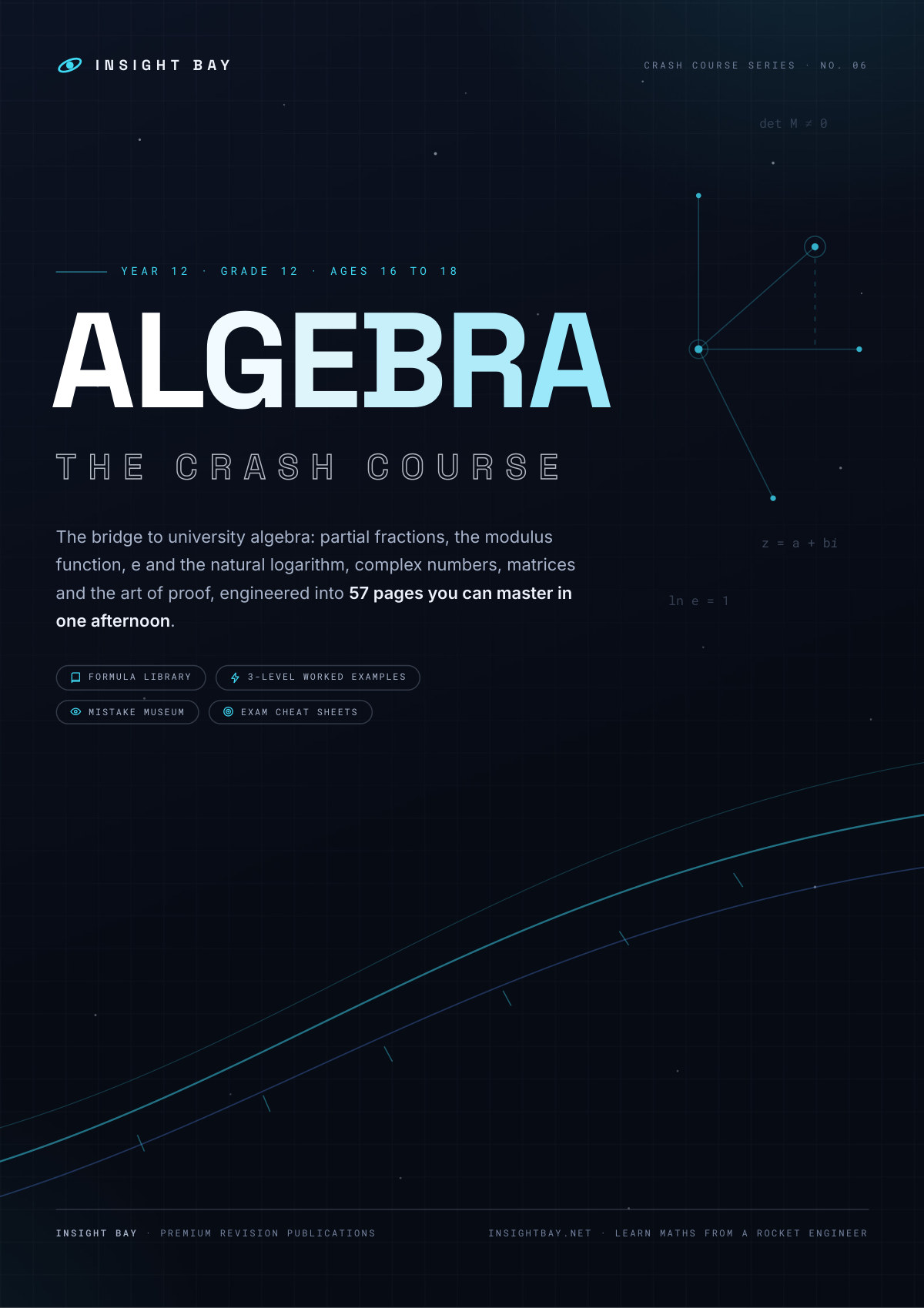
Complex numbers, matrices, and the art of proof: the point at which mathematics stops being calculation and becomes argument. The most demanding volume in the library, and the one written for the student who is already ahead.
57 pages · seven parts · a full Exam Lab
Two editions included · Study for print, Screen for dark
Circle theorems held to proof standard, tangents and normals by calculus, and vectors in three dimensions: the same mathematics used to put a spacecraft where it needs to be.
57 pages · seven parts · a full Exam Lab
Two editions included · Study for print, Screen for dark
The Question Bank
Practice, Not Teaching
The Field Guides teach the year. This one does the opposite: a thousand questions and nothing else, for the student who already has the mathematics and now has to prove it against a clock.
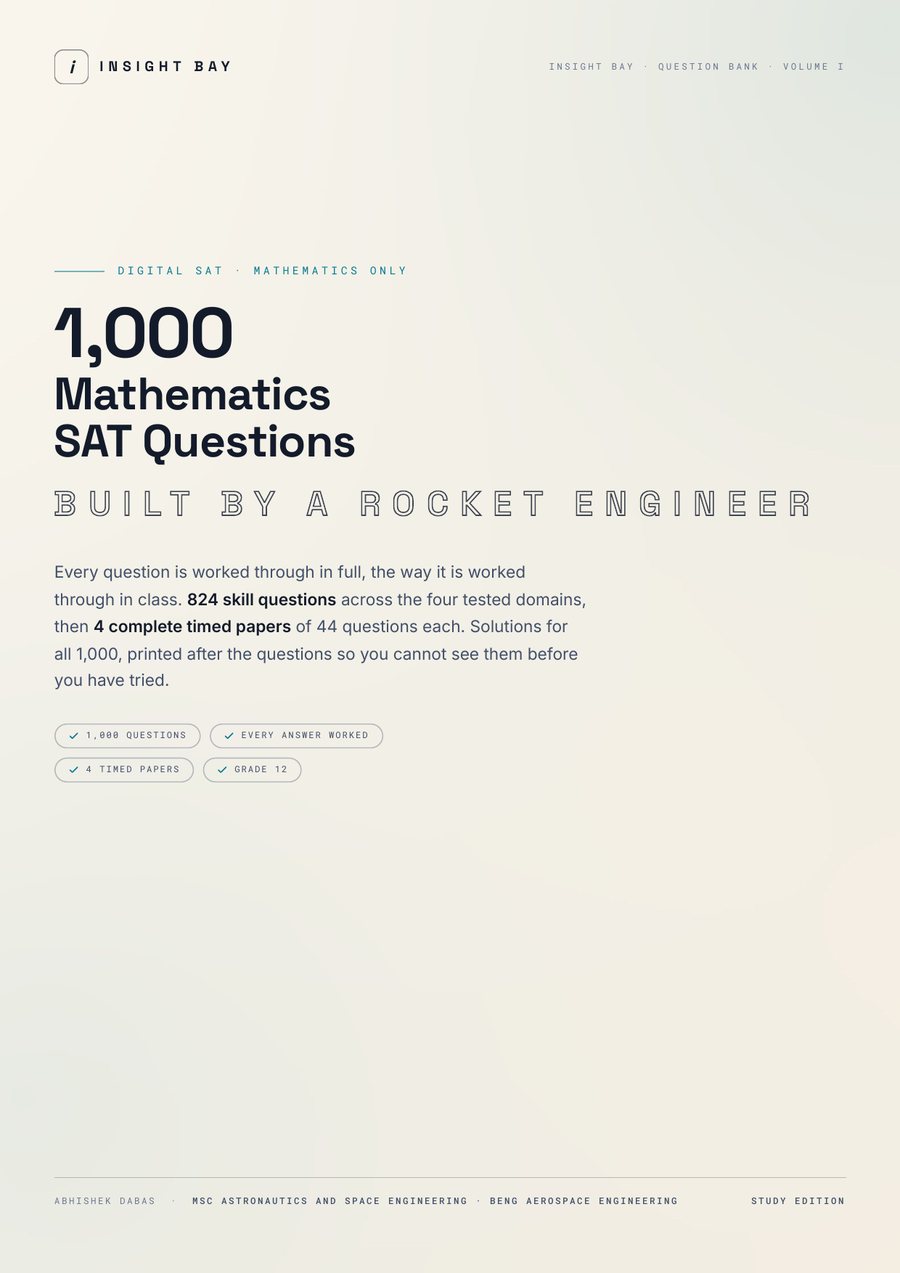
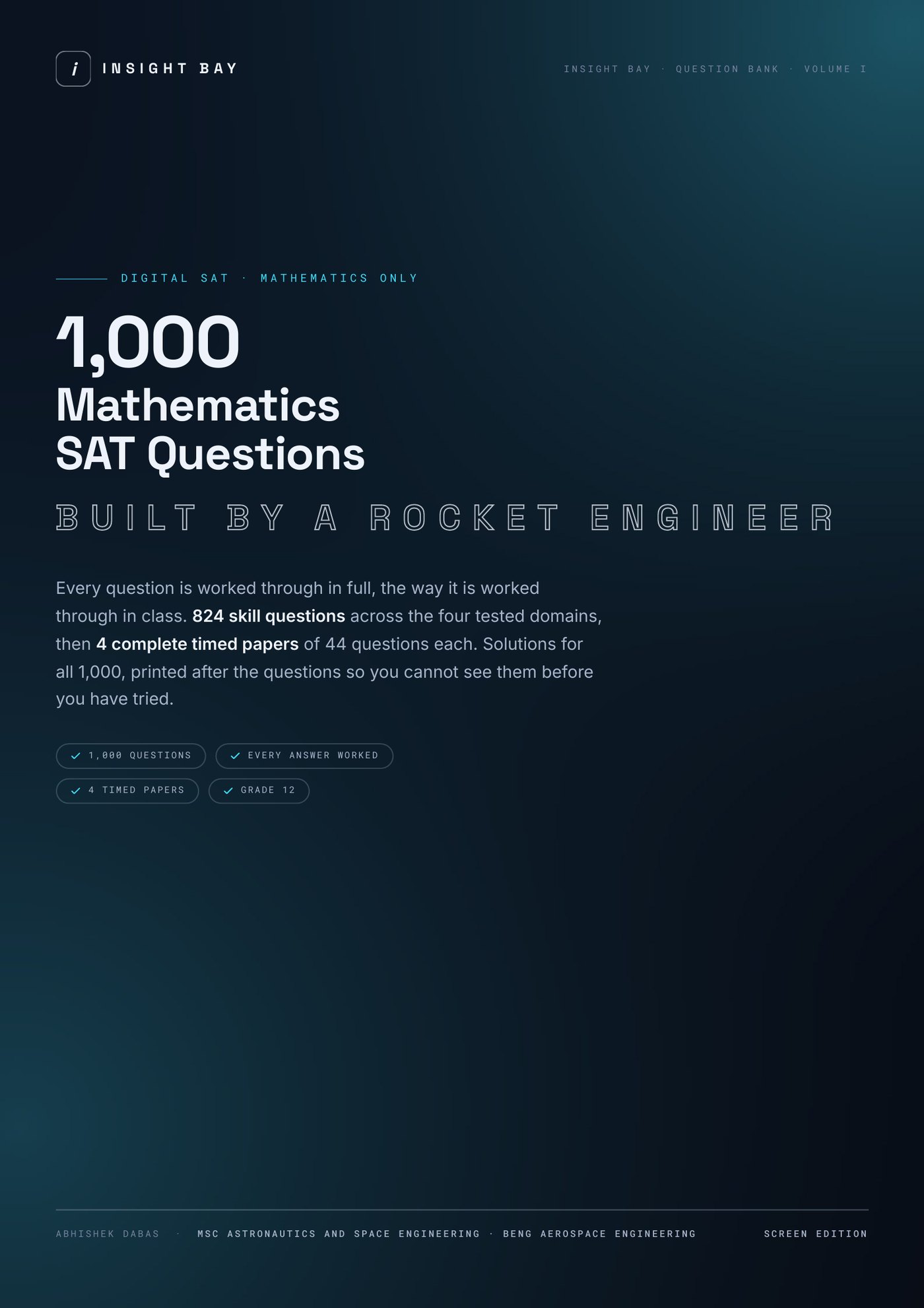
One thousand questions for the Mathematics section of the digital SAT: 824 sorted by skill across the four tested domains, then 176 assembled into four complete timed papers of 44. Every one carries a full worked solution.
519 pages · nine parts · four timed papers
Two editions included · Study for print, Screen for dark
The complete Library
Eight volumes, shelved as a set.
From the language of algebra to vectors in three dimensions, and the geometry every examination is built on. They were written as one work, in sequence, and they read best that way.
IIIIIIIVVVIVIIVIII
$632$349
Eight volumes · 475 pages · 16 PDFs in one download. 30-day money-back guarantee.Every family who begins a programme receives the complete Library. It is not a bonus, it is the reading.Individual volumes are available above.
If you have already bought a volume, its price is credited in full against your first programme.
What lands in your folder
Eight volumes · 475 pages · 16 PDFs in one ZIP
Study cream pages, made for printingScreen dark pages, made for reading
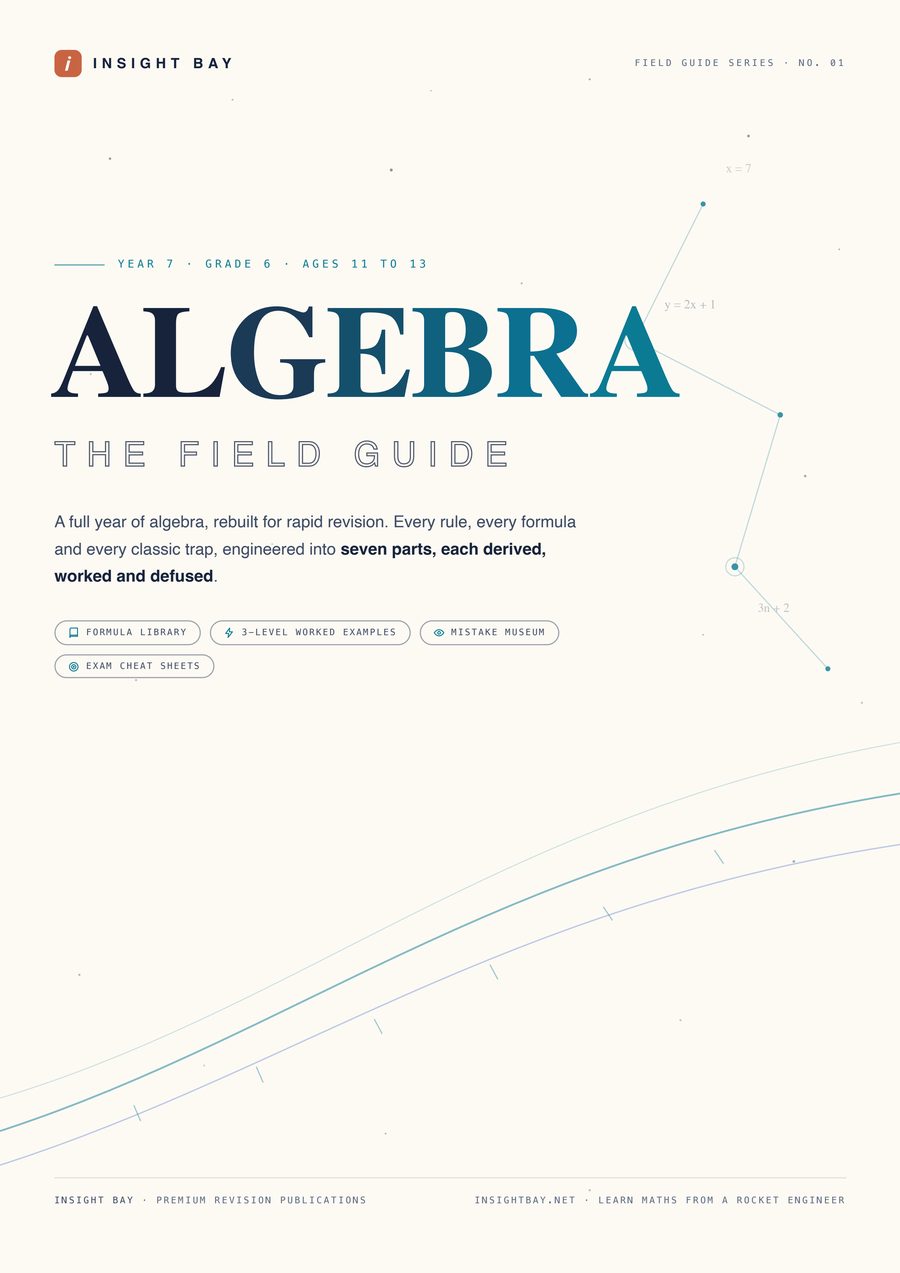
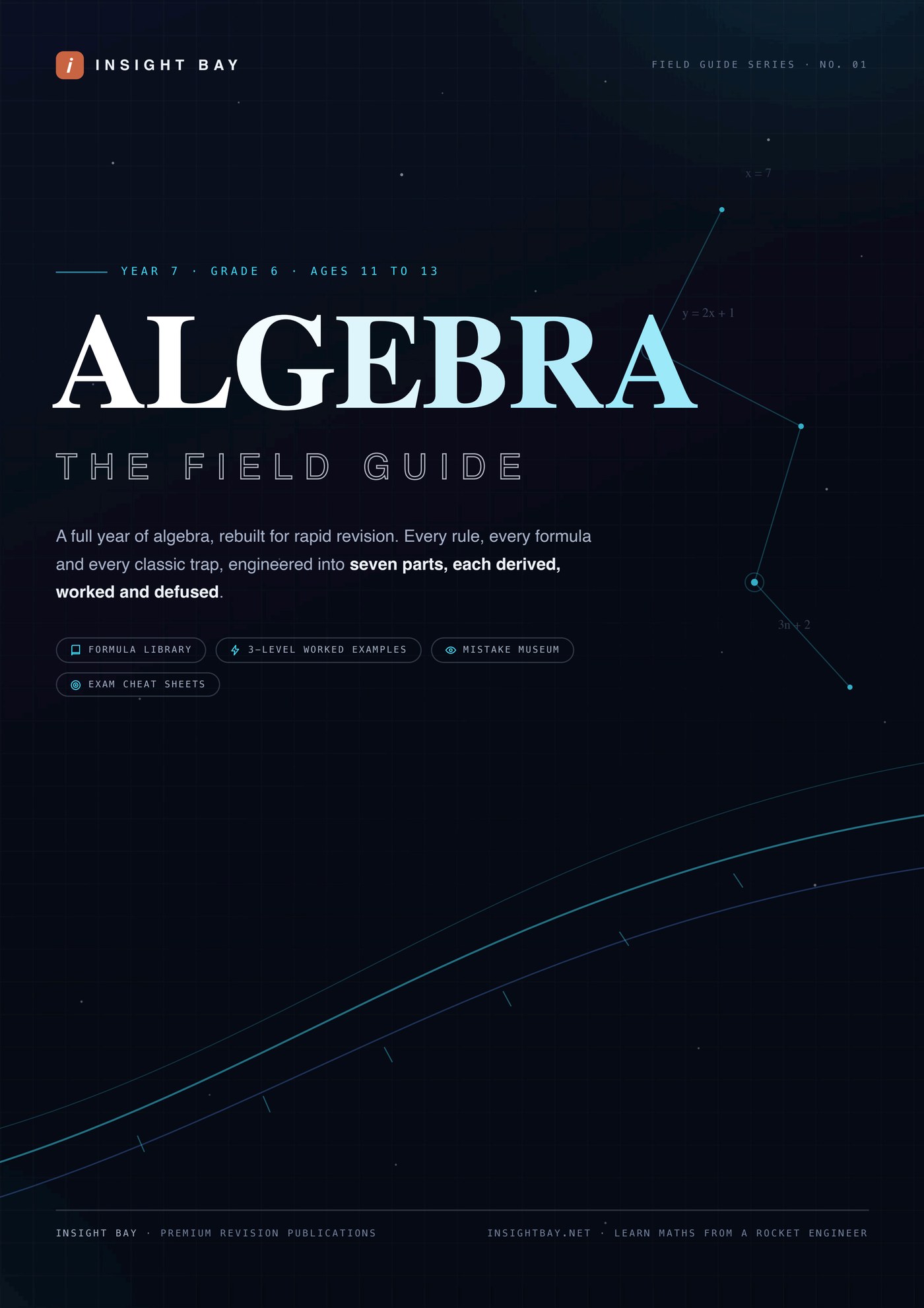
IAlgebra: The LanguageYear 7 · Grade 661 pagesStudyScreen
IIAlgebra: The MachineryYear 8 · Grade 761 pagesStudyScreen
IIIAlgebra: The QuadraticYear 9 · Grade 861 pagesStudyScreen
IVAlgebra: The CurveYear 10 · Grade 961 pagesStudyScreen
VAlgebra: The FunctionYear 11 · Grade 1060 pagesStudyScreen
VIGeometry: The Ground RulesYear 11 · Grade 1057 pagesStudyScreen
VIIAlgebra: The Complex PlaneYear 12 · Grade 1157 pagesStudyScreen
VIIIGeometry: Space and ProofYear 12 · Grade 1157 pagesStudyScreen
Every volume arrives in both editions, so the same page can be printed on cream or read on dark. One purchase, one download, nothing to upgrade to.
Eight volumes in print. A ninth is in preparation.
How to use a Field Guide
Three passes, not one reading
1
Read the formula library first
Not to memorise it, but to see how few genuinely separate ideas a year of mathematics contains. Most years contain about nine.
2
Work the three-level examples with a pencil
If level two is comfortable and level three is not, you have found the exact edge of what your child understands. That is the most useful thing this book can tell you.
3
Sit the Exam Lab cold, then visit the Mistake Museum
Marks lost in the Lab almost always appear in the Museum. That is the point of both, and it is the pass most students skip.
Delivery, currency and payment are handled at checkout and take under a minute.
Questions
What parents actually ask
Do I have to choose between the Study and Screen editions?
No. One purchase gives you both files, in one download. They are the same volume, typeset twice: cream paper for printing, dark paper for reading on a screen. There is no upgrade and no second price. All eight volumes are published in both editions.
My child is already ahead. Is this still useful?
Yes, and that is who most of it is written for. The three-level examples exist so that a strong student can skip straight to level three and still find something they cannot immediately do. Volume VI in particular assumes a student who has finished the syllabus and wants the argument underneath it.
Will this replace an educator?
No, and it is not written to. A book cannot notice that a child is guessing, cannot slow down at the moment that matters, and cannot tell which of the key facts they only appear to understand. What it can do is put the whole year in front of them in the order it was built, so that the time you do spend with an educator is spent on the part that needs a person.
Which volume does my child need?
Volume
UK, Ireland
United States, Canada
Australia, New Zealand
Ages
I
Year 7
Grade 6
Year 7
11 to 12
II
Year 8
Grade 7
Year 8
12 to 13
III
Year 9
Grade 8
Year 9
13 to 14
IV
Year 10
Grade 9
Year 10
14 to 15
V
Year 11
Grade 10
Year 11
15 to 16
VI
Year 11
Grade 10
Year 11
15 to 16
VII
Year 12
Grade 11
Year 12
16 to 17
VIII
Year 12
Grade 11
Year 12
16 to 17
If your child sits between two volumes, take the lower one. Nothing is lost by being certain of the year underneath.
What is actually inside a volume?
A typeset A4 PDF of 57 pages, or 60 for Volume V, that reads on any device and prints cleanly at home. Seven parts, a formula library, three-level worked examples, trap and fix pairs, the Mistake Museum, twenty-three numbered key facts, and an Exam Lab of twenty-four questions with every solution worked in full. Open any volume with "Look inside" to read the spreads before you decide.
Is it tied to one examination board?
No. Each volume covers the shared core of its year across the UK, US, Canadian, Australian, New Zealand and Singapore systems, cross-checked against Oak National Academy units. No single board is assumed, and nothing in a volume is wasted on a family sitting a different paper.
Delivery, currency and refunds
Your PDF unlocks on the confirmation screen the moment payment is confirmed, and a secure download link is emailed to you. Prices display and charge in US dollars. If a volume is not what you expected, write to hello@insightbay.net and I will put it right. Your licence is for your own family: yours to keep and print, not to resell or redistribute.
Written by
Abhishek Dabas, MSc Astronautics and Space Engineering, BEng Aerospace Engineering. One author, no contributors.
Verified
Every calculation and every worked solution has been checked before publication.
Coverage
The shared core of six national curricula, cross-checked against Oak National Academy units.
Editions
Study and Screen, typeset from one source. Corrections are issued to every reader who owns the volume.
The Complete Library · all eight volumes · $632$349
30-day money-back guarantee · the price is credited in full against your first programme
The practice
The books are what I could write down.
Everything in these eight volumes is the part of the teaching that survives being written down. What does not survive is the part where I watch a child work and notice, four seconds before they do, that they are about to guess.
If you want that part, it begins with a complimentary assessment: forty-five minutes with your child, thirty with you, and a written note on what I found. The practice is deliberately small.